
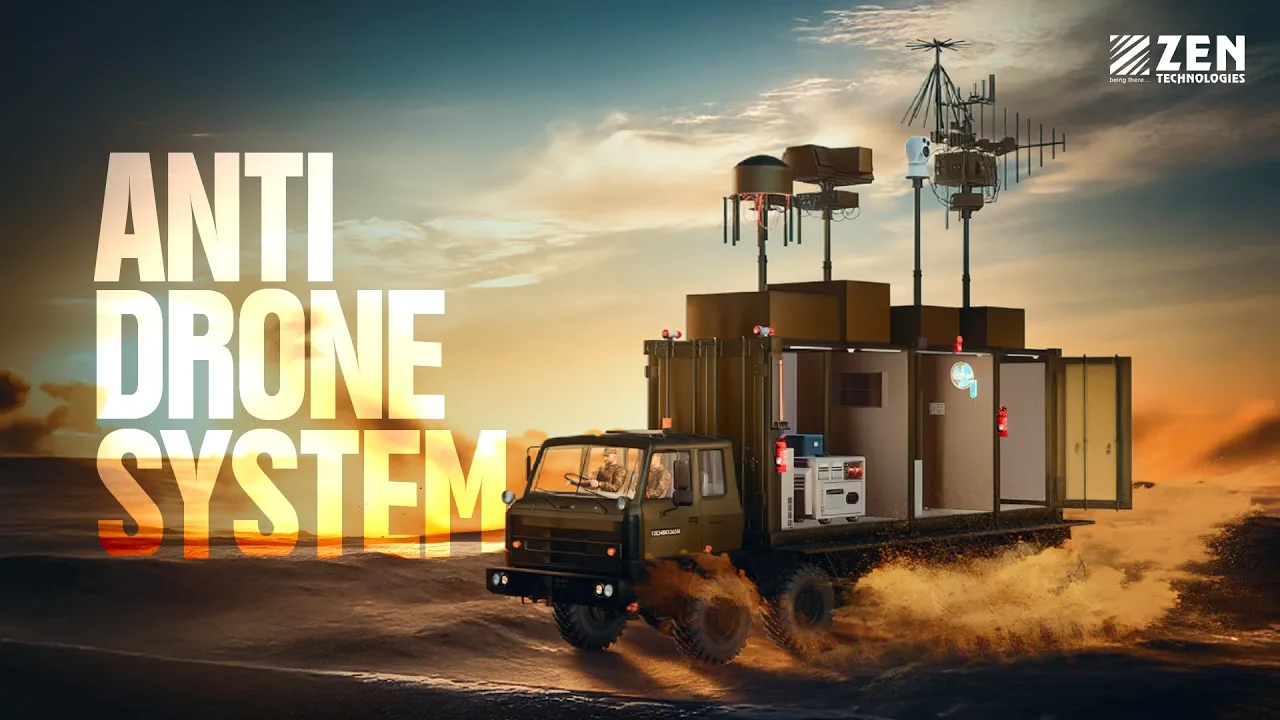
Anti Drone System / Counter Drone System (CUAS)
The Zen Anti Drone System is a combat-proven counter drone system (C-UAS) that detects, classifies and tracks hostile drones using RF drone detection, radar and day/night camera sensors, then neutralizes the threat by jamming the drone’s control and navigation links, with hard kill options for physical destruction or capture.
Zen Anti Drone Systems are in service with India’s armed forces under Ministry of Defence and Indian Air Force orders, and operated as a counter-drone grid during Operation Sindoor in May 2025. Soft kill (RF and GNSS jamming) and hard kill weapons such as the L-70 air defence gun are all controlled from a single Data Fusion and Command Centre.
Anti Drone System Specifications
| Drone detection range | Up to 20 km |
|---|---|
| RF detection band | 70 MHz – 12 GHz |
| RF detection range | 5 – 25 km |
| Radar | X-band, mechanically steered; 1 – 10 km depending on the drone’s radar cross-section (RCS); provides range, azimuth and elevation |
| Jamming | ISM bands and GNSS; 2 – 10 km; directional antennas; jams frequencies detected by the RF detector or set by the operator |
| Camera tracking (VDIT) | Optional; day/night cameras on a servo-based mount |
| Hard kill | Air defence guns, missile launchers, remote controlled weapon stations (RCWS), drone kill system, interceptor drones and net-based drone catcher, all commanded from the Data Fusion & Command Centre |
| Configurations | Vehicle-based, container-based, stationary and man-portable |
| Capabilities | Multi-target detection, drone swarm detection and jamming, 24/7 all-weather operation |
| Use cases | Airports and borders, oil and gas installations, public spaces and infrastructure, VIP and homeland security |
Counter Drone System Modules: Multi-Sensor Architecture
- RF Based Drone Detector (RFDD)
- Video based Drone Identification & Tracking (VDIT)
- RADAR
- Data Fusion and Command Centre (DFCC)
- Drone RF Jammer (DRFJ)
- Hard kill
RF Based Drone Detector (RFDD)
The RF Based Drone Detector (RFDD) finds drones by listening for the radio link between a drone and its ground control centre (GCC). It continuously scans frequencies from 70 MHz to 12 GHz, and when it finds a frequency of interest it locks on and monitors the signal. An array of receive antennas then estimates the direction of both the drone and its GCC. The RFDD detects drone RF signals at ranges of 5 km to 25 km.
Video based Drone Identification & Tracking (VDIT)
The Video based Drone Identification and Tracking (VDIT) module confirms what the RF detector has found. Its day and night cameras sit on an automatic servo-based mount that receives direction commands from the Data Fusion and Command Centre (DFCC). The cameras capture video and images of the drone, and video processing software automatically detects the drone and starts tracking it.
Counter Drone System Radar
The radar detects autonomous drones, which fly without a radio link to an operator and so cannot be found by the RFDD. An X-band mechanically steered radar detects drones at 1 km to 10 km, depending on the drone’s radar cross-section (RCS), and gives precise target coordinates, including range, azimuth and elevation. Its feed goes to the Data Fusion and Command Centre for remote monitoring of the threat.
Data Fusion and Command Centre (DFCC)
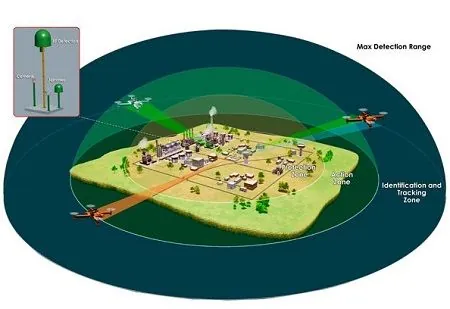
The Data Fusion and Command Centre (DFCC) combines data from the RFDD, VDIT and radar into a single picture of the threat. Built-in algorithms detect and classify drones using data from all sensors, and an integrated display shows the threat zones on a map. Operators define the monitored area and the threat and identification zones from the console, while spectrum and waterfall screens give a detailed view of detected emissions. The DFCC is also linked to the hard kill interface, so guns and other counter-drone measures are controlled from the same console.
Drone RF Jammer (DRFJ)
The Drone RF Jammer (DRFJ) is the soft kill drone jammer of the system. It cuts the link between the drone and its GCC by jamming ISM bands, GNSS signals and any other intercepted frequencies at the same time. It automatically takes the frequencies found by the RFDD, generates jamming waveforms and radiates them through directional antennas. Operators can also set jamming frequencies manually. The effective jamming range is 2 km to 10 km.
Hard Kill Anti Drone System
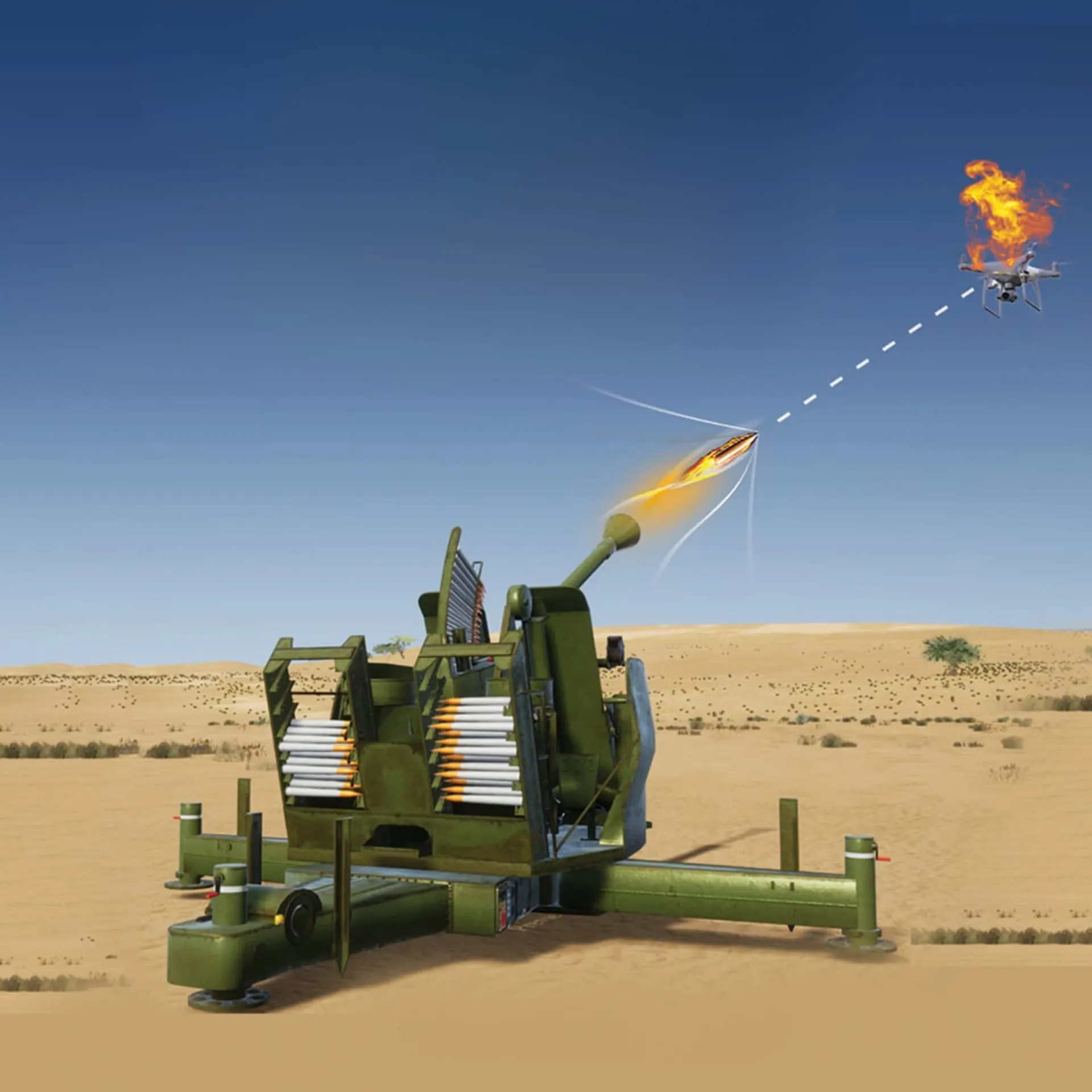
To neutralize drones that cannot be jammed, such as autonomous drones, Zen Anti Drone System (CUAS) integrates hard kill options: standard air defence guns, missile launchers, remote controlled weapon stations (RCWS) such as Parashu, a drone kill system, interceptor drones and a net-based drone catcher. Hard kill commands are issued from the Data Fusion and Command Centre (DFCC). For gun-based kill, the gun interface passes the target coordinates to the weapon and aligns it with the drone’s ingress direction to destroy it physically. To capture a rogue drone and land it safely, the net-based option launches a dedicated drone with a hanging net, which suits small drones carrying potentially damaging explosives.
Anti Drone System Configurations
The Zen Anti Drone System is offered in four configurations to suit different operational requirements:
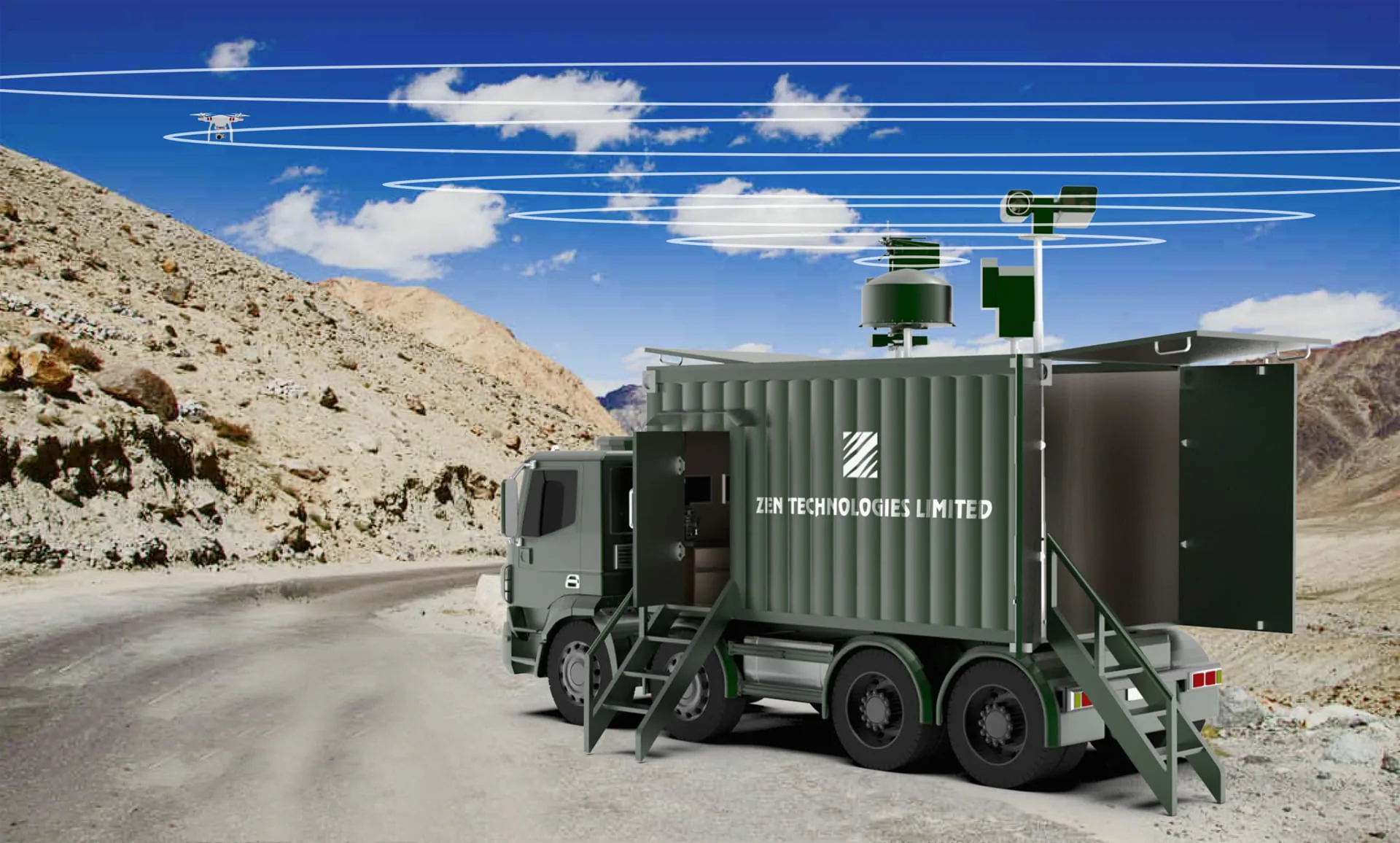
- Vehicle-based: RF detector, radar, jammer, camera mast and the drone monitoring and control station mounted on a truck with its own generator, for mobile deployment.
- Container-based: the complete system housed in a transportable container that can be relocated and set up at the site to be protected.
- Stationary: tripod-mounted sensors and jammer with a command console, for fixed installations.
- Man-portable: an RF drone detector (400 MHz – 6 GHz), Data Fusion & Command Centre and drone RF jammer with omni-directional antennas. It detects drones up to 5 km and jams up to 3 km, and can be carried by soldiers, pack animals, ATVs, bikes or UGVs.
Countering Drone Swarms
Zen ADS detects and tracks multiple drones at the same time and can jam a swarm of drones, operating 24/7 in all weather conditions. Autonomous drones that fly without a radio link cannot be jammed, so they are detected by radar and engaged through the hard kill interface. Multiple systems can work together as a counter-drone grid, as they did in Operation Sindoor.
For high-threat sites, the multi-layered counter drone system Vyomkavach stacks four layers of defence: swarm detection out to about 20 km; jamming out to about 10 km and kamikaze interceptor drones out to about 8 km; micro-missile interception out to about 2.5 km; and RCWS engagement out to about 2 km.
Where Counter Drone Systems Are Used
- Airports and country borders
- Oil and gas installations
- Public spaces and infrastructure
- VIP protection and homeland security
Anti Drone System Deployments and Orders
- July 2026: High-Altitude Man-Portable Anti-Drone System (MPADS) unveiled for mountain warfare.
- May 2026: India’s first AI-powered, fully integrated anti-drone system launched at North Tech Symposium, Prayagraj.
- November 2025: ?289 crore Ministry of Defence orders to upgrade Zen ADS, based on operational feedback from Operation Sindoor.
- October 2025: ?37 crore Ministry of Defence order for Anti Drone Systems with hard kill.
- May 2025: Zen ADS operates in Operation Sindoor as part of India’s air defence grid, working with IACCS and the Army’s Akashteer system — how Zen’s counter-drone grid performed in Operation Sindoor.
- June 2024: Hard-kill Anti Drone System (ADS HK) delivered to the Army Air Defence College, Gopalpur, cueing the L-70 air defence gun.
- September 2023: ?227.65 crore Ministry of Defence order for the supply of Anti Drone Systems, with Zen as the single vendor.
- September 2021: ?155 crore Indian Air Force order for Counter Unmanned Aircraft Systems; systems delivered in phases during 2022–23.
Anti Drone System - Product Gallery
Counter Drone System - Product Brochure
Anti Drone System - Related Products
-
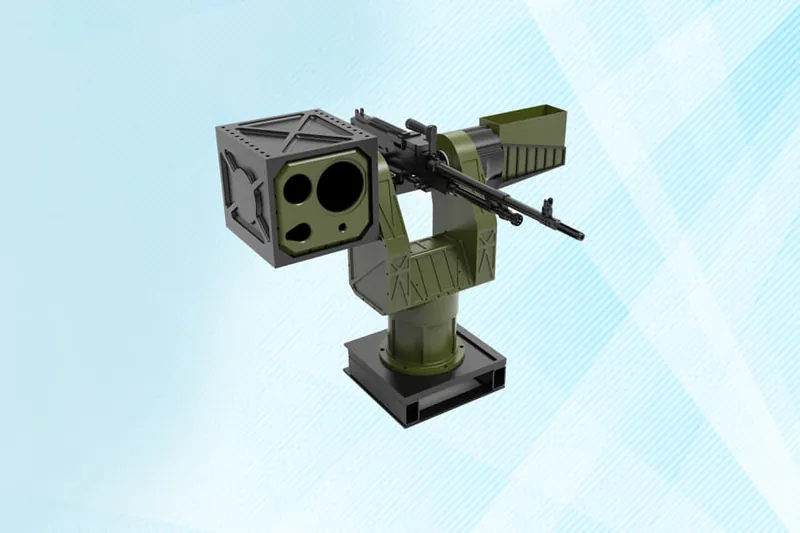
RCWS - 7.62 x 51 MMG (Parashu)
The RCWS - Parashu/Calibers is a versatile remote-controlled weapon station designed for optimal performance in various operational scenarios includin...
Know more