

The Training Challenge in Armored Gunnery
In armored warfare, mobility enables manoeuvre—but gunnery delivers decisive effect. The effectiveness of a tank crew is ultimately judged by its ability to detect, engage, and destroy targets accurately and rapidly under combat conditions. However, achieving and sustaining high standards of crew gunnery proficiency remains one of the most resource-intensive and constrained aspects of armored training.
Live gunnery training demands significant availability of tanks, ammunition, ranges, and safety infrastructure. High ammunition costs, limited range access, safety risks during live firing, and wear on weapon systems restrict the frequency of realistic training. Night firing, adverse weather engagements, and complex tactical scenarios are difficult to conduct repeatedly under live conditions. As a result, crews often receive limited exposure to varied combat situations, impacting consistency and readiness across formations.
In an operational environment where armored units are expected to deliver precision fire under all conditions, these constraints create a clear capability gap. Crew gunnery simulation has emerged as a critical solution to bridge this gap—enabling realistic, repeatable, and standardized training without the limitations of live firing.
Crew Gunnery Simulation for Better Combat Performance
Crew gunnery simulation replicates the complete gunnery environment of a tank, including gunner and commander stations, sights, controls, fire control systems, and target engagement dynamics. By accurately modelling weapon behaviour and battlefield conditions, simulation-based training enables crews to develop, refine, and sustain gunnery skills without dependence on live ammunition or platform availability.
Unlike generic simulators, modern crew gunnery simulation systems are platform-specific. They mirror the actual crew layout, control logic, and engagement procedures of operational tanks, ensuring that training outcomes translate directly to live combat performance. This makes simulation not merely a training aid, but a force multiplier for armoured formations.
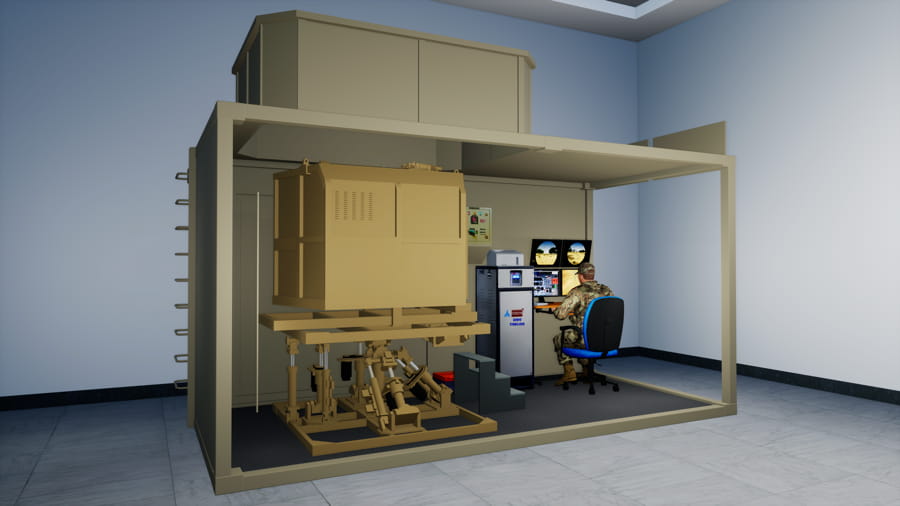
Tank Crew Gunnery Simulator
Building Gunnery Proficiency from Fundamentals to Advanced Engagements
Crew Familiarization and Gunnery Procedures
For both novice and experienced crews, mastery of gunnery begins with procedural correctness. Crew gunnery simulation allows repeated practice of:
- Gunner and commander station familiarization
- Sighting systems and reticle usage
- Ammunition selection and loading procedures
- Standard engagement drills and safety protocols
These fundamentals can be rehearsed extensively under instructor supervision, ensuring accuracy and coordination before progression to complex engagements.
Realistic Engagement Scenarios Across Operational Environments
One of the defining strengths of crew gunnery simulation is the ability to replicate diverse battlefield conditions. Crews can train across multiple operational scenarios, including:
- Desert and plains warfare
- Semi-urban and built-up areas
- Defensive and offensive postures
- Multiple and fleeting target engagements
Simulation enables repetition of high-stress combat scenarios that are impractical or unsafe to conduct frequently in live environments. This repeated exposure sharpens reaction time, engagement accuracy, and decision-making under pressure.
Fire Control System and Ballistic Realism
Modern crew gunnery simulation accurately replicates fire control system behaviour, ballistic computation, and weapon response. Crews experience realistic effects of:
- Range estimation and lead calculation
- Ammunition type and ballistic trajectory
- Target movement and relative speed
- Weapon stabilization and firing errors
By experiencing the consequences of incorrect inputs or delayed decisions, crews develop a deeper understanding of weapon employment—leading to improved accuracy during live firing.
Commander–Gunner Coordination and Crew Integration
Effective gunnery is a crew effort. Simulation enables focused training on commander–gunner coordination, including:
- Target designation and handover
- Fire orders and engagement priorities
- Communication discipline under combat conditions
This integrated training strengthens crew cohesion and ensures that commanders and gunners function as a synchronized team—an essential requirement for success in high-tempo armoured engagements.
Instructor Control, Objective Assessment, and Standardization
Crew gunnery simulation systems include dedicated instructor stations that allow real-time monitoring and control of training sessions. Instructors can:
- Observe crew actions and engagement decisions
- Introduce faults, delays, or unexpected target appearances
- Conduct replay and after-action reviews
Performance metrics such as reaction time, hit probability, ammunition usage, and engagement accuracy can be objectively analyzed. This enables standardized evaluation across batches and formations, reducing subjectivity and improving training consistency.
Enhancing Training Efficiency and Ammunition Economy
By shifting a substantial portion of gunnery training to simulation, armored forces can significantly reduce expenditure on live ammunition and range resources. Simulation allows unlimited repetitions of firing drills without additional cost or system wear.
More importantly, crews enter live firing phases with higher baseline proficiency. This improves safety, reduces ammunition wastage, and maximizes the value of limited live gunnery opportunities.
Flexible Deployment to Support Unit-Level Training
Crew gunnery simulation systems can be deployed in fixed training establishments or as containerized units at formation and unit locations. This flexibility supports decentralized training while maintaining standardized quality, allowing crews to train closer to their operational environment.
More importantly, crews enter live firing phases with higher baseline proficiency. This improves safety, reduces ammunition wastage, and maximizes the value of limited live gunnery opportunities.
Summary
Crew gunnery simulation has become an indispensable component of modern armored training. By addressing the limitations of live gunnery, it enables safe, repeatable, and cost-effective development of crew proficiency across a wide range of combat scenarios.
Through realistic replication of crew stations, fire control systems, ballistic behavior, and battlefield conditions, simulation enhances accuracy, coordination, and confidence. For armored forces tasked with delivering decisive firepower under all conditions, crew gunnery simulation is not an optional enhancement—it is a critical enabler of combat readiness and operational effectiveness.
Leave feedback about this