
The Training Challenge in Armored Vehicle Driving
Effective employment of an armored fighting vehicle begins with assured mobility. Regardless of firepower or protection, a Main Battle Tank can only achieve operational effectiveness when driven by a confident, skilled, and situationally aware driver. However, driver training within armored formations continues to face persistent structural challenges.
Live tank training is resource-intensive. Limited availability of serviceable vehicles, high fuel consumption, accelerated wear and tear, and safety risks for inexperienced drivers restrict both the frequency and depth of practical driving exposure. Replicating diverse terrain conditions—such as desert tracks, gradients, trenches, bridges, and water obstacles—requires extensive infrastructure and range availability, which is not always feasible. These constraints directly affect training throughput, standardization, and readiness across units and formations.
As armored forces are expected to maintain high levels of preparedness across varied operational environments, there is a growing requirement for a controlled, repeatable, and cost-effective approach to driver training. In this context, driving simulation has emerged as a critical capability enabler rather than a supplementary training aid.
Driving Simulation as a Capability Enabler
Modern driving simulation systems are designed to replicate the driver’s compartment, controls, and vehicle behavior of armored platforms with a high degree of accuracy. By recreating the physical layout, control logic, and response characteristics of a tank, simulation-based training allows drivers to acquire practical skills without reliance on live vehicle availability.
Unlike generic vehicle simulators, armored driving simulation focuses on platform-specific procedures and operational challenges. This ensures that training outcomes are directly transferable to live vehicle operation, reducing transition time, minimizing training risk, and improving overall efficiency. Simulation enables structured learning, from basic familiarization to advanced driving tasks, under consistent and instructor-controlled conditions.
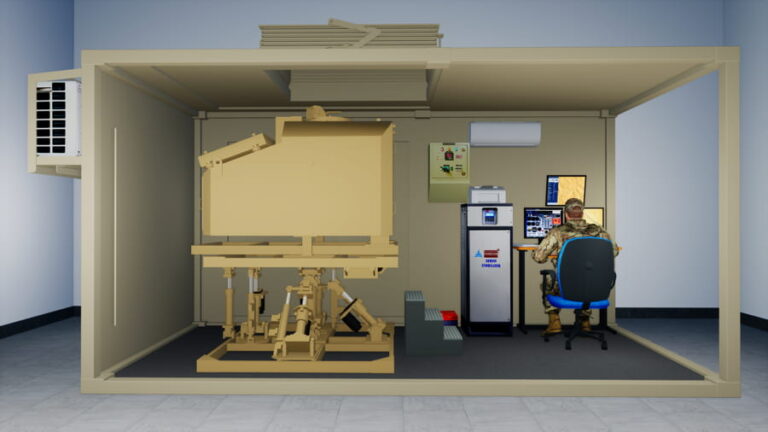
Tank Driving Simulator
Core Elements of Driver Training Through Simulation
Controls Familiarization and Starting Procedures
For novice drivers, mastering complex controls and procedures represents the first major hurdle. Driving simulation allows repeated hands-on practice of essential elements, including:
- Instruments, indicators, and gauges
- Accelerator, clutch, brake, and gear coordination
- Standard starting procedures such as battery start, air start, and combined start drills
These procedures can be rehearsed repeatedly under instructor supervision, ensuring procedural correctness and confidence before exposure to live vehicles.
Progressive Development of Driving Skills
Simulation-based training supports a structured progression of driving skills. Trainees typically begin with basic movement on plain terrain, gradually advancing to more demanding conditions. Training progression includes:
- Basic driving techniques on level ground
- Day and night driving operations
- Coordination of clutch, accelerator, brakes, and gear changes
This progressive approach helps develop muscle memory and situational awareness in a safe and controlled environment, significantly reducing learning curves during live training.
Training for Terrain and Obstacle Negotiation
One of the most significant advantages of driving simulation is the ability to repeatedly practice terrain-specific and high-risk scenarios that are difficult to replicate in live conditions. Simulation enables realistic rehearsal of:
- Trench crossing
- Negotiation of vertical obstacles below one meter
- Gradient and slope handling
- Crossing of bridges, including military-laid bridges
In addition, simulation supports training for loading and unloading on tank transporter trailers and railway rolling stock. These tasks are critical for operational and strategic mobility but are rarely practiced frequently due to logistical constraints in live environments.
Advanced Driving Scenarios for Operational Readiness
Beyond basic proficiency, driving simulation enables exposure to advanced scenarios aligned with operational deployment requirements. These include:
- Driving in desert terrain with reduced traction
- Operations in built-up areas with restricted manoeuvre space
- Shallow and deep fording operations
- Navigation using gyro-based indicators
Such scenarios expose drivers to realistic vehicle behavior under varying visibility, traction, and spatial constraints. This builds decision-making ability and confidence while eliminating the safety risks associated with live execution during early training stages.
Realism Through Motion and Visual Fidelity
Training effectiveness in driving simulation is enhanced through physical and sensory realism. Motion platforms with multiple degrees of freedom provide realistic translational and rotational cues, enabling drivers to better understand vehicle inertia, braking response, and obstacle negotiation.
Out-of-the-window visual systems aligned with periscope views provide accurate depth perception and situational awareness. When combined with a faithful compartment mock-up and fully functional controls, the simulation environment closely mirrors real-world tank driving conditions, reinforcing correct driving behavior and responses.
Instructor Control, Assessment, and Training Standardization
Driving simulation systems incorporate dedicated instructor stations that allow real-time monitoring, control, and assessment of trainees. Instructors can observe driver actions, communicate through intercom systems, and introduce training variables such as terrain changes or procedural faults.
This instructor-led framework ensures adherence to standard operating procedures and enables objective performance evaluation. As a result, simulation-based training supports consistent and standardized outcomes across batches, units, and formations.
Flexible Deployment for Armored Training
To meet the operational realities of armored formations, driving simulation systems are designed for flexible deployment. Containerized configurations allow rapid transportation and setup at training establishments, unit locations, or forward areas. Where infrastructure permits, fixed installations can be established to support long-term training requirements.
This flexibility enables decentralized training while maintaining standardized training quality, reducing dependency on centralized facilities.
Impact on Training Efficiency and Fleet Availability
By shifting a significant portion of driver training to simulation, armored forces can reduce reliance on live tanks for basic and intermediate training stages. This leads to lower fuel consumption, reduced maintenance demands, and preservation of vehicle life for operational tasks.
Equally important, simulation improves training safety and allows repeated exposure to critical scenarios, ensuring drivers achieve required competency levels before operating live platforms. The result is improved readiness, higher confidence among drivers, and better utilization of armored assets.
Summary
Driving simulation has become an essential component of modern armored driver training. By addressing limitations associated with live vehicle training, simulation enables safe, standardized, and cost-effective development of driving skills across a wide range of terrains and operational scenarios.
Through accurate control replication, realistic motion and visual feedback, instructor-led assessment, and flexible deployment, driving simulation enhances training efficiency while preserving fleet availability. For armored forces tasked with maintaining high readiness across diverse operational environments, driving simulation represents a logical and effective evolution of driver training methodology.