
The Problem: Preparing Soldiers for an Unpredictable Battlefield
Modern warfare is no longer linear, predictable, or confined to a single domain. Today’s battlefields are shaped by rapid technological evolution, asymmetric threats, multi-domain operations, and compressed decision timelines. Armored formations face drone swarms and precision-guided munitions; air-defence units counter fast and low-signature aerial threats, and infantry units operate in dense urban and hybrid environments.
Traditional training methods and legacy simulators, while valuable, struggle to replicate this complexity. Scripted scenarios, static enemy behavior, and limited adaptability reduce realism and fail to prepare soldiers for the uncertainty of real combat. Live training, on the other hand, is resource-intensive, costly, and carries inherent safety risks.
This gap between training and real-world combat readiness presents a critical challenge: how do armed forces train for unpredictable, high-intensity warfare without escalating cost, risk, or time?
Artificial Intelligence (AI) is emerging as the answer — and at Zen Technologies, we are leading this transformation in combat simulation and defence training.
AI-Powered Combat Simulation: A Paradigm Shift in Military Training
AI fundamentally changes how combat simulators operate. Instead of pre-defined, predictable outcomes, AI-driven systems create dynamic, evolving battlefields that respond intelligently to trainee actions.
At Zen Technologies, our AI-powered combat simulators replicate the uncertainty, pressure, and decision-making demands of real operations. These systems continuously assess trainee performance and adapt scenarios in real time — altering enemy tactics, terrain complexity, visibility, weather conditions, and threat density.
This ensures that no two training sessions are the same, forcing soldiers to think, adapt, and respond as they would in actual combat.
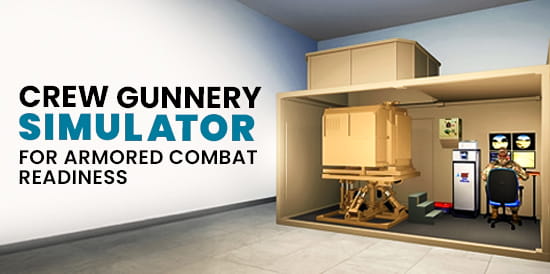
A prime example is Zen’s patented T-90 Tank Crew Gunnery Simulator, which uses AI to generate diverse mission environments, including:
- Urban combat operations
- Desert and high-temperature scenarios
- Night and low-visibility engagements
- Multi-threat and multi-directional attacks
As the commander or gunner reacts, the AI recalibrates the mission — increasing complexity for skilled trainees or adjusting difficulty to reinforce learning where required. This level of realism transforms simulation from basic skill training into true mission rehearsal.
Core AI Technologies Driving Zen’s Combat Simulation Ecosystem
Adaptive Scenario Generation
Zen’s simulators employ AI models that continuously evaluate trainee actions — accuracy, reaction time, tactical choices, and coordination. Based on this assessment, the system dynamically modifies the scenario.
High performers encounter increased threat density and complexity, while trainees needing improvement receive structured challenges that reinforce learning objectives. This personalized training approach maximizes effectiveness across all experience levels.
Machine Learning–Based Performance Analytics
Every action within the simulator is recorded and analyzed using machine learning algorithms. From target acquisition time to engagement accuracy and decision sequencing, the system converts raw data into actionable performance insights.
This turns the simulator into a virtual instructor, enabling:
- Immediate identification of strengths and weaknesses
- Objective performance evaluation
- Data-driven progress tracking for commanders andins
- tructors
AI-Enabled Instructor Operator Station (IOS)
Zen’s AI-powered Instructor Operator Station acts as an intelligent training assistant. It provides instant feedback, highlights errors, suggests corrective actions, and allows real-time scenario adjustments without disrupting training flow.
The result is faster learning cycles, consistent instruction standards, and enhanced training safety
AI-Controlled Multi-Agent Warfare Simulation
Modern combat is networked and multi-platform. Zen’s AI systems simulate coordinated hostile forces across tanks, infantry, drones, vehicles, and air assets. This allows trainees to practice full-spectrum operations with realistic enemy tactics and behaviours, preparing them for joint and combined-arms missions.
Zen Technologies: Leading AI-Driven Defence Training Solutions
Zen’s commitment to AI-enabled training extends across multiple platforms:
- Infantry Weapons Training Simulator (IWTS)
Incorporates AI-driven characters and scenarios for marksmanship, tactical judgment, and engagement training, supported by real-time instructor monitoring and analytics.
- AI-Enabled Instructor Operator Station (IOS)
Integrated across platforms to deliver adaptive training control and data-driven performance assessment.
These systems collectively position Zen as a leader in intelligent combat training ecosystems, not just standalone simulators.
The Future of AI in Defence Training
At Zen Technologies, we view AI as a long-term force multiplier for armed forces. Our vision includes:
- Next-generation combat simulation
- Human–AI teaming
- Autonomous and adaptive training environments
- Scalable mission rehearsal platforms
- Enhanced readiness for land, naval, and air operations
By integrating machine learning, adaptive automation, and high-fidelity simulation, we ensure that soldiers train smarter, safer, and more effectively.
Summary
AI is redefining how militaries prepare for modern warfare. By replacing static, scripted training with intelligent, adaptive simulation, armed forces gain realistic mission rehearsal, data-driven performance insight, and improved combat readiness.
Through AI-enabled platforms such as the T-90 Tank Simulator, IWTS, Instructor Operator Station, Zen Technologies is leading this transformation in defence training.
We are not merely building simulators — we are building the future of combat readiness, ensuring today’s forces are fully prepared for tomorrow’s operational challenges.